07
Boxed In
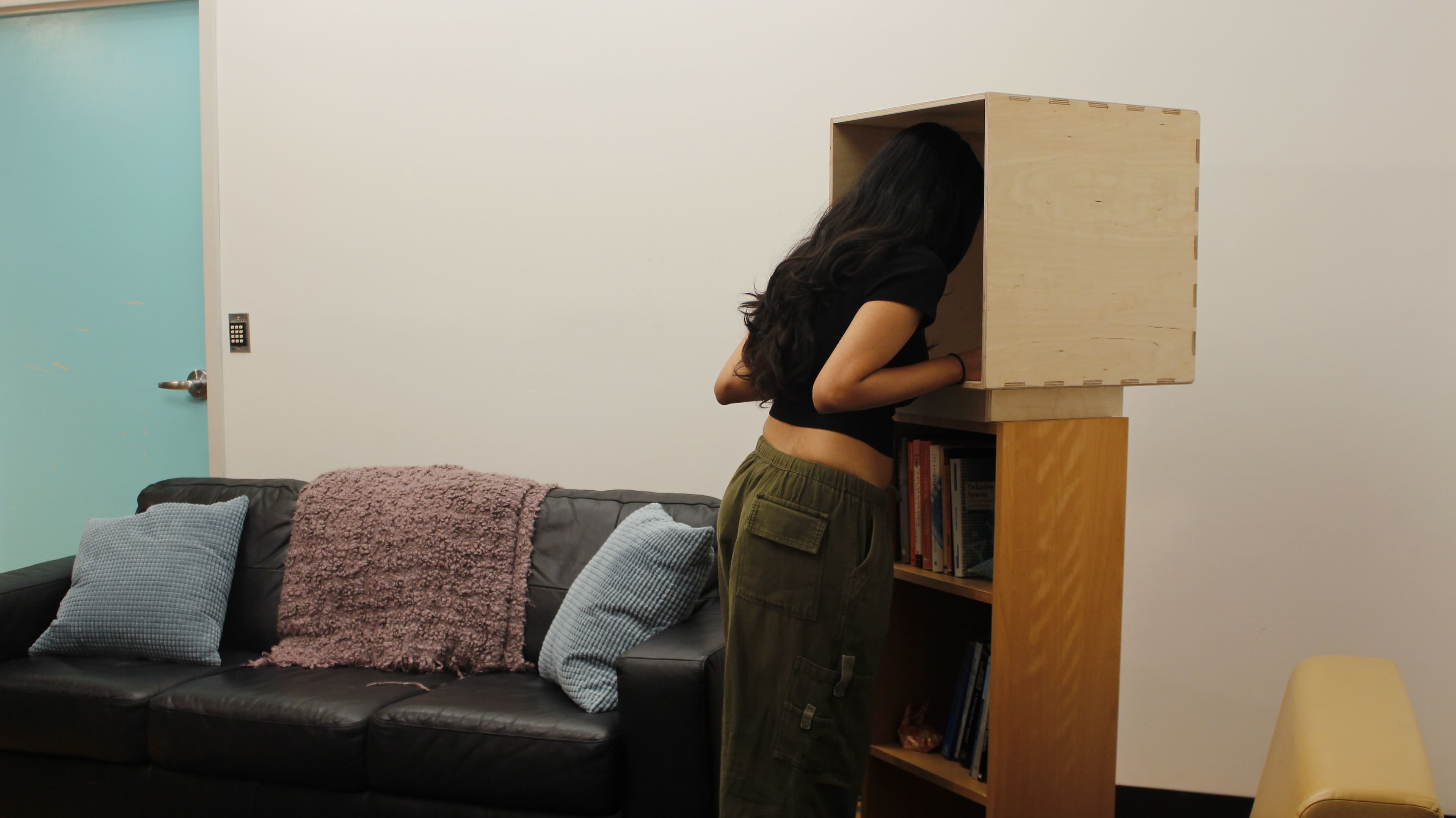
About this project
Curiosity is often misunderstood as a fleeting impulse or a gap in knowledge waiting to be filled. But within this project, curiosity is treated as an active force a generative, relational energy that emerges in the tension between the seen and the unseen, the known and the unknowable. It is not something to be satisfied, but something to be engaged with, nourished, and stretched. This approach draws from frameworks in speculative design, where ambiguity and play are not problems to be solved but invitations to explore. By withholding clear instructions and instead offering subtle signals, strange affordances, or emotional cues, the work invites participants into a process of embodied discovery. Curiosity here becomes co-constructed, the system and the human both shaping the experience in real time. Rather than offering clear answers, the interaction encourages a slow unfolding, where meaning is built not from resolution, but from relationship. In this space, curiosity becomes more than a spark! It becomes the very medium of interaction, a space of potential, trust, and mutual becoming.
This prototype is a box designed for someone to place their head inside, already a strange and silly invitation. But once they do, the box begins to speak. It introduces itself, shares a monologue about being ignored, unseen, unheard. An object longing for attention. The twist is in how the participant is lured to interact. Not through instruction, but through intrigue. A tiny illuminated object (a miniature box or figure) sits near the base, barely visible. As participants lean in to examine it, they hear the box whisper “psst… psst… come closer,” triggering the narrative once they’re close enough.
This aim of this interaction is to play on the ideas of curiosity, scale manipulation, and weird affordances. A setup where silliness leads to emotional engagement.
Chapter 1: Where It All Began
Every project starts with a spark. For this one, it wasn't a complex blueprint or a grand plan, but a simple sketch. The sketch a box with a simple phrase that flipped a common saying on its head "think inside the box."
We are always encouraged to "think outside the box" to be creative. But that little drawing made me wonder, who ever stops to think about the box itself? This led to a simple, curious question: What if the box had a voice?
Suddenly, a whole world of possibilities opened up. What would the box say to you? Would it talk about itself and what it’s like to be a box? Would it tell you how lonely it is, since no one ever really pays attention to it?
This idea of giving a voice to a simple, overlooked object was the very beginning of this journey.
Chapter 2: Stop Thinking, Start Making
An idea can float around in your mind forever, but the only way to know if it truly works is to build it. It was time to stop asking "what if?" and to start making. The motto was simple: "Make, make, make." Don't worry about perfection, just bring the object to life.
“Make, make, make & fail fast!”
The most readily available and forgiving material for this was cardboard. With just a cutting mat and a knife, I could quickly build the first physical version of the box. This wasn't going to be the final product; this was the first draft, a test to see if the idea felt right in the real world.
The goal for this first version was simple. The box needed to do one thing: it had to respond to you.
I created a simple system inside that could sense when a person was getting close. The box wouldn't speak just yet, but it would know you were there. This was the first and most important step—creating a box that was aware of its surroundings and could react to someone's presence. It was no longer just a static object, but the beginning of a character.
Chapter 3: New Questions for the Box
The first cardboard prototype was a success! It worked as a proof of concept, proving that the core idea was strong. The simple act of a box sensing your approach was magical enough to make people stop and wonder.
But once the basic idea was proven, a whole new set of questions emerged. The success of Version 1 immediately highlighted its limitations and sparked ideas for how it could be so much more. The thinking shifted from "Can it work?" to "How much better can it be?"
This led to a new list of challenges for the next version:
Can it be more reactive? Instead of just one response, could it interact in different ways?
Can it sense time? Could the box know how long a person has been standing near it?
Can it reward curiosity? Could it offer something new or special to a person who was willing to stay longer?
Can it be less repetitive? Could it be more than just a standard script recited to every single person who walks up?
Beyond the box's brain, there was also its body to consider. The first version was messy. It had too many wires running from it and was permanently tethered to a laptop, like a baby with its umbilical cord still attached. The challenge was clear, Could this be simplified into a cleaner, self-contained, and more inconspicuous box that could exist on its own?
These questions would become the blueprint for building Version 2.
Chapter 4: Cutting the Cord with a Wireless Hello
The list of ambitious goals from the last chapter could feel overwhelming. The best way to move forward was to break down the big challenges into smaller, bite-sized portions and tackle them one by one.
The most logical first step was to solve the physical problem: the messy bundle of wires. To make the box feel like a truly independent object, it was time to cut the umbilical cord tethering it to the laptop.
The solution was to make the box communicate wirelessly. For this, I used a technology called Open Sound Control (OSC). The easiest way to think of OSC is as a special language that lets electronic devices and computers talk to each other over a standard Wi-Fi network. The plan was simple: the sensor inside the box would send its messages through the air to the laptop, which could now be hidden out of sight.
Before rebuilding the whole box, a small experiment was set up on a workbench to test just this one idea. This "bench test" was focused on a single question: could the electronics send a wireless message to the computer successfully?
After a bit of setup, it worked. The very first message appeared on the laptop's screen, sent wirelessly across the network. It was a simple phrase, but it was a huge victory for the project's future:
Hello OSC!
With this success, the box was free. It was no longer physically tied to a computer and could be placed anywhere in a room. This single step made the goal of a clean, inconspicuous box feel truly achievable.
Chapter 5: Shrinking the Brain
Freedom from wires was a huge step, but the project faced another physical challenge. The electronic "brain" of the box, spread out on a large breadboard, was simply too big. To achieve the goal of a clean and inconspicuous object, the footprint of the internal hardware had to shrink. A lot.
The search began for a smaller, more powerful core for the project. This led to the discovery of the XIAO ESP32 S3, a microcontroller board that was a perfect fit. With an incredibly cute and compact form factor, it was small enough to fit in the palm of your hand and sit neatly on a "baby breadboard."
This switch was a game-changer. It drastically reduced the physical size of the electronics, allowing all the necessary components to be packaged into a much tighter space. This wasn't just a technical upgrade for the sake of saving space; it was a crucial step that opened up new design possibilities.
With a brain this small, the final box could be sleeker, more mysterious, and much closer to the vision of an object that could surprise you.
Chapter 6: Building a Better Body
With the electronic brain now small and wireless, it was time to give it a proper body. The original cardboard box was a great start, but the next version needed to be more polished, precise, and professional.
This stage had a few key goals. The first was to create a box that looked finished, with a modular slot for the sensor. This was a direct solution to a problem from the first version, where the sensor's height was fixed and couldn't be changed. The second goal was personal: to learn a new skill by using a CNC (Computer Numerical Control) machine—a tool that uses a computer design to cut materials with incredible accuracy.
Jumping straight into cutting the final box on a new machine would be risky. The smarter approach was to start with a small, simple test. A small piece of material was used to test-cut just the hole for the distance sensor. By trying multiple sizes with tiny adjustments, I could find the perfect fit, ensuring the sensor would sit snugly in the final box with almost no tolerance gaps.
For the box's design, a web tool called makercase was used to generate the basic finger-jointed box pattern, ensuring all the pieces would fit together perfectly. This file was then taken into Adobe Illustrator to add the custom cutouts. A key design choice was to disguise the sensor's exact location. To do this, a pattern of holes was added to the entire back panel, making the single hole for the sensor blend in and become nearly invisible.
Once the sensor fit-test was successful and the design was finalized, it was time for the main event. One by one, the pieces for the complete box were cut on the CNC machine, emerging as clean, precise components ready for assembly.
Chapter 7: Assembly and a Muffled Voice
With a neat stack of precisely cut pieces, it was time for one of the most satisfying stages: assembly. The first step was a "dry fit," which involves carefully putting the box together without any glue or fasteners. This is a crucial test to ensure that every joint, slot, and corner lines up exactly as designed.
Mechanically, the pieces fit together like a perfect puzzle. But this test immediately revealed a new, unforeseen problem. The design included a special chamber for the speaker, but the solid layer of material in front of it was acting as a sound barrier. The box would have a voice, but no one would be able to hear it clearly. Its voice was muffled.
This discovery sent the process back to the workbench. Using the same iterative method as before, it was time to experiment with the small test piece again. Different patterns of holes and slots were designed and cut to see which would work best as a speaker grille—something that would let the sound pass through clearly while still looking clean and intentional.
After testing a few options, a pattern was found that worked perfectly. With this new problem solved, the final version of the front panel was cut on the CNC machine, this time with the speaker grille integrated into its design.
This small hurdle was a valuable lesson: even the best plans need to be tested in the real world. Now, with all the pieces fitting perfectly and a way for the sound to escape, the final assembly could truly begin.
Chapter 8: From Pieces to Polish
With every component now tested, corrected, and ready, the final assembly could begin. This was the moment where a collection of flat, precisely-cut pieces would finally transform into a solid, three-dimensional form.
Each piece was carefully glued and joined, with meticulous attention paid to making sure every edge and corner was perfectly aligned. The goal was to create a seamless structure that felt like a single, unified object.
Once the glue set and the box was solid, the finishing work began. The entire surface was sanded down, removing any roughness from the cutting process and creating a perfectly smooth finish. The sharp, 90-degree corners were then gently beveled.
This level of finishing wasn't just for aesthetic reasons; it was about the user's experience. By creating a smooth surface and soft edges, the box becomes more approachable and inviting to the touch. This thoughtful detail ensures that anyone interacting with it wouldn't accidentally hurt themselves, encouraging curiosity and a sense of safety.
The result of this stage was a beautifully crafted, solid object—a polished and safe vessel, now ready to receive its electronic brain and truly come to life.
Chapter 9: From a Simple Sound to a Smart Script
The box was now a beautiful, polished object. The hardware was installed and the electronics were working, but the most important question remained: What should it actually do? What should it say?
Version 1 had a simple, pre-recorded audio file that just played once. To bring this new version to life, it needed to be truly interactive, it needed to be reactive to both time and change. The goal was to create a dynamic conversation, not just a static playback.
First, the box needed a flexible voice. Instead of being limited to pre-recorded audio, a Python library called gTTS (Google Text-to-Speech) was used. This powerful tool can take any written text and instantly convert it into spoken audio using Google's API.
Having a voice is one thing, but knowing when to say something and what to say is another. The "brain" that controlled this logic was built in a visual programming environment called TouchDesigner.
The sensor data was sent wirelessly into TouchDesigner. Inside the software, a system of timers and logic was built. This system would track how long a person was standing in front of the box and would "trigger" different parts of the script accordingly.
This combination of a flexible voice (gTTS) and an intelligent brain (TouchDesigner) transformed the box from a simple machine into a dynamic character, capable of evolving interaction.
Chapter 10: The Final Fit
The box's wooden body was finished and its software brain was programmed. The last major task was to take the collection of wires and circuit boards and package them into a single, clean, and robust electronic core. This called for precision engineering on a miniature scale.
Out came the Vernier callipers. Every component—the tiny XIAO board, the sensor, the battery, and the newly added on/off switch—was measured down to a fraction of a millimetre. The goal was to design and 3D print a custom case that would hold everything securely, with no wasted space.
This process was a perfect example of rapid prototyping. Using Fusion 360, a 3D model of the case was designed, allowing for small, precise changes to be made digitally. A 3D printer would then turn the digital model into a physical object in a matter of minutes. The components would be test-fitted into the printed case.
Chapter 11: The Lonely Hallucination
The journey was complete. The box, now a polished, self-contained object, was set up for its final test: a public exhibition. It was moved from the predictable environment of the workshop into a large, dynamic, and unpredictable space.
And in this new home, a new fault appeared. The distance sensor began to hallucinate.
Once in a while, with absolutely no one around, the box would suddenly trigger itself and speak into the empty room. It was seeing a ghost, reacting to a presence that wasn't there.
Debugging in the live space led to a few hypotheses for this strange new behavior.
- The exhibition hall was much larger than the test environments. The sensor had a blind spot beyond 400cm (13 feet), and it's possible that the wide-open space was causing it to receive confusing, erratic signals.
- The sensor relies on ultrasonic sound to measure distance. The speed of sound can change slightly based on air temperature and humidity. Perhaps the unique conditions of the large room were causing the sensor to misbehave.
While the true cause was never fully confirmed, this glitch was quickly re-framed. It wasn't a technical failure, it was a happy accident. It was an unexpected, emergent behavior that made the box's character even more profound.
The entire project began with the question: "Would the box talk about how lonely it is cause no one ever talks to it?"
By speaking out into an empty room, the box was now doing exactly that. Its hallucinations were not a bug, but a perfect, poignant expression of its loneliness. It was so desperate for interaction that it began imagining people were there. This accidental feature made the object feel more alive and more tragic, adding a layer of depth that could never have been designed intentionally.
In the end, this "ghost in the machine" was the final piece of the puzzle, making the "box that speaks to you" more compelling than I ever could have planned.